


In 2026, blockchain technology isn’t just transforming— it’s reshaping the entire digital security landscape. As web3 adoption accelerates, cybercriminals are increasingly targeting the decentralized systems with sophisticated attacks. Hackers exploit smart contracts, execute wallet phishing scams, and uncover layer-2 vulnerabilities—driving an urgent need for advanced blockchain security platforms and web3 security solutions.
If you build, invest, or depend on blockchain systems, you must understand how blockchain security will evolve in 2026.
Strong security isn’t just about preventing hacks—it’s about building trust, enabling mass adoption, and protecting the foundation of the future digital economy.
Why Blockchain Security Platforms Matter More Than Ever?
Blockchain was initially celebrated for its immutability and transparency. But decentralization alone isn’t just the perfect security. Indeed, cybercriminals adapt fast learning but blockchain’s open nature can also expose weaknesses. Once deployed, smart contracts cannot be changed, so any bugs or vulnerabilities become permanent risks, such as
- Wallets and keys become targets for social engineering
- Cross-chain bridges introduce complex vulnerabilities
- Decentralized apps (dApps) expand the attack surface
Similarly, in 2026, these threats have multiplied as the web3 ecosystems matured. According to industry data: blockchain hacking incidents reported billions in losses annually. Moreover, this stark reality underscores why dedicated blockchain security platforms are no longer as optional — they are essential infrastructure.
In fact, modern blockchain security stands out by combining on-chain analysis, real-time threat detection, AI-powered prevention, and decentralized trust guarantees. Notably, these advanced security platforms help developers and enterprises to defend against the cyber threats at a machine speed, far faster than traditional methods.
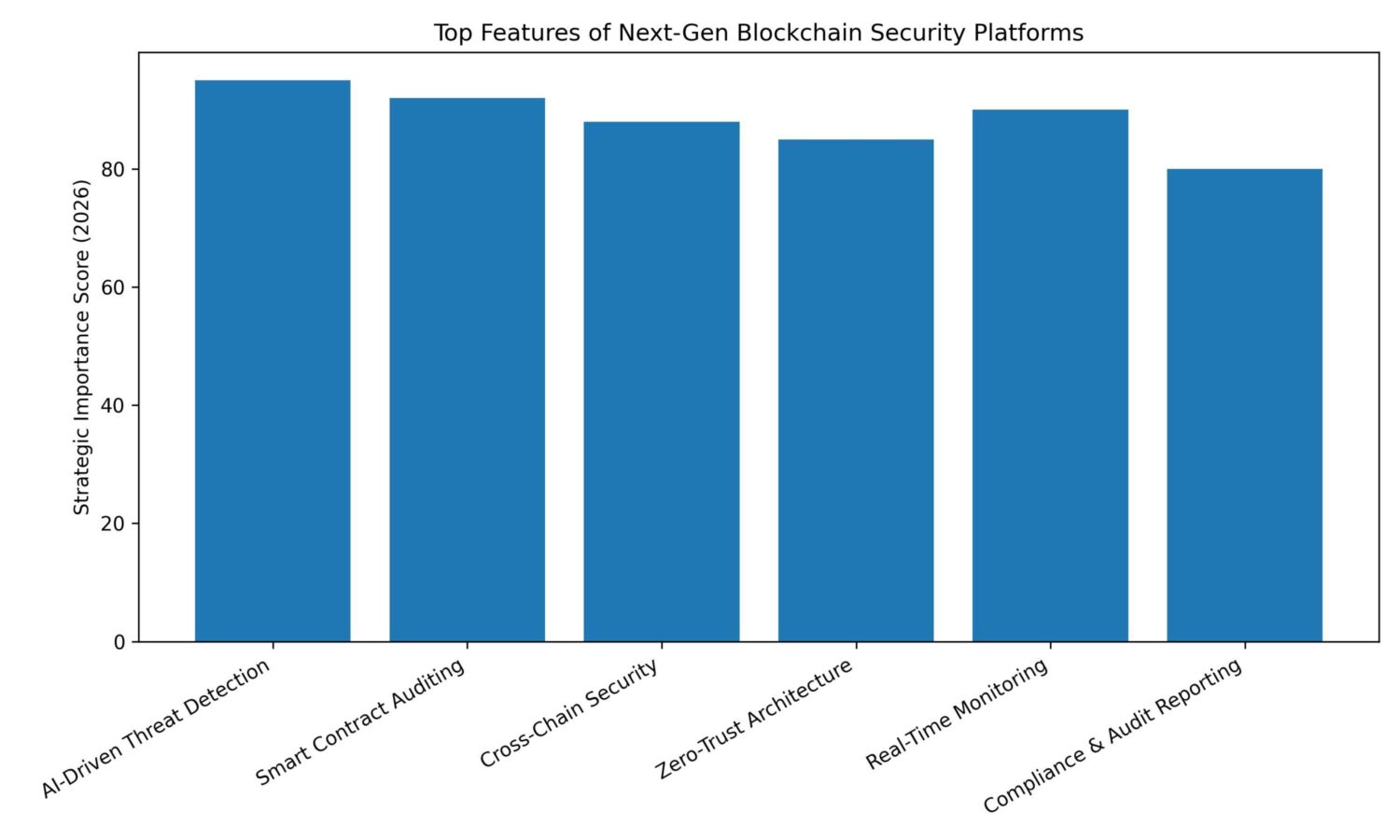
Top Features of Next-Gen Blockchain Security Platforms
As we move deeper into 2026, leading blockchain security solutions share several key capabilities that set them apart:
1. Smart Contract Auditing & Formal Verification
Smart contracts are powerful but small code errors lead to major financial loss. Today’s top platforms combine
- Semantic code analysis
- Formal verification techniques
- Real-time scanning for known exploit patterns
Moreover, this ensures that contracts behave exactly as intended before the deployment and sometimes even after in live environments.
2. AI-Driven Threat Intelligence & Anomaly Detection
Artificial intelligence and machine learning now power real-time threat detection. Despite of relying on static rules, advanced platforms use AI to
- Detect abnormal transaction sequences
- Identify the emerging exploit signatures
- Predict risk based on behavior analytics
Similarly, faster threat responses and fewer false positives protect billions of dollars, flowing across blockchain networks every day.
3. Cross-Chain & Bridge Protection
Interoperability drives web3 growth. But bridges between blockchain networks create high-risk security zones. Additionally, the leading platforms provide
- Secure relayer verification
- Automated rollback mechanisms
- Immutable audit trails
Nevertheless, with these defenses, cross-chain transactions can be streamlined without compromising safety.
4. Zero-Trust Blockchain Architecture
Zero-trust doesn’t mean eliminating trust—it means continuously verifying every access and transaction. Also, in blockchain security
- Every actor is authenticated
- Access is minimal by design
- Actions are continuously evaluated
Indeed, this security model blocks internal threats and prevents unauthorized privilege escalation, therefore, protecting the decentralized finance (DeFi) platforms, decentralized autonomous organizations (DAOs), and enterprise blockchain systems.
How Blockchain Security Platforms Empower Real-World Use Cases?
Indeed, blockchain isn’t just for cryptocurrencies. In 2026, decentralized technologies are transforming multiple industries, including
- Supply chain provenance systems – ensuring transparency and traceability of goods
- Tokenized real estate and assets – enabling secure, fractional ownership of valuable assets
- Web3 gaming economies – powering in-game assets and cross-platform interoperability
- Identity and credential networks – providing secure, verifiable digital identities
- Decentralized finance (DeFi) – offering borderless financial services and investment opportunities
Across all these domains, blockchain security platforms play a mission-critical role in protecting assets, data, and user trust.
DeFi Security: Reducing the Exploit Risk
Indeed, DeFi platforms hold billions of dollars in user assets, and a single exploit can destroy confidence, liquidity, and the platform’s reputation. In particular, modern blockchain security platforms provide essential protections, including
- Pre-deployment smart contract audits – catching vulnerabilities before they go live
- Live monitoring of liquidity pools – detecting abnormal activity in real time
- Alerting for unusual token movements – preventing hacks and unauthorized transfers
These tools allow DeFi developers and enterprises to stay one step ahead of attackers, while reassuring users that their funds are safe. From DeFi to tokenized assets, supply chains, and identity networks, blockchain security platforms are essential to protect assets, maintain user trust, and drive mass adoption of decentralized technologies in 2026.
Enterprise Blockchain: Ensuring Regulatory Compliance
Large enterprises are increasingly adopting blockchain to boost transparency and operational efficiency, but regulatory scrutiny remains high. To enumerate, modern enterprise blockchain security platforms help organizations stay compliant by providing
- Immutable audit logs – ensuring every transaction and change is traceable
- Automated regulatory reporting – simplifying compliance with auditors and regulators
- Enforced access policies – preventing unauthorized actions on sensitive blockchain systems
With these tools, enterprises can innovate confidently on blockchain while maintaining governance and legal compliance.
Web3 Gaming & NFTs: Protecting Digital Assets
As NFT markets and blockchain gaming ecosystems boom, attackers increasingly target hot wallets and in-game economies.
Advanced blockchain security platforms reduce risk by
- Protecting private keys with advanced encryption
- Flagging suspicious account behavior in real time
- Isolating wallets in secure enclaves
Furthermore, these measures protect players and developers, thus boosting trust, adoption, and monetization in web3 gaming and NFT platforms.
Emerging Trends in Blockchain Security for 2026
Although blockchain adoption accelerates in 2026, security innovations are evolving just as fast. For instance, from community-driven audit marketplaces to AI-powered developer tools and self-protecting smart contracts, the next generation of blockchain security is designed to proactively prevent attacks, safeguard assets, and build trust across DeFi, web3 gaming, NFTs, and enterprise systems.
Furthermore, these emerging trends are shaping how developers, enterprises, and users interact with decentralized networks, ensuring that security keeps pace with innovation.
Decentralized Security Marketplaces
A new paradigm in blockchain security is community-driven marketplaces, such as
- Independent auditors contribute findings to a shared security pool.
- Rewards are distributed based on verified security audits.
- Decentralized oracles validate audit outcomes.
Eventually, this opens the blockchain security to community scrutiny, thus increases the trust and reduces central points of failure.
AI Co-Pilots for Blockchain Developers
In 2026, developers use AI assistants trained on blockchain security data to build safer projects. The role of these co-pilots include
- Suggest secure code snippets in real time
- Warn developers about insecure patterns as they type
- Automatically patch vulnerabilities before deployment
This approach lowers barriers to secure blockchain development, especially for emerging projects and startups with limited resources.
Self-Protecting Smart Contracts
Modern smart contracts are evolving from passive code to active defenders. To explain, advanced platforms now embed self-monitoring routines that
- Pause execution under attack
- Alert governance groups instantly
- Roll back suspicious activity automatically
Surely, this innovation transforms smart contracts into autonomous, self-protecting programs, improving safety across DeFi, gaming, and enterprise blockchain systems.
Choosing the Right Blockchain Security Platform in 2026
With many solutions available, choosing the best platform comes down to
- Coverage –Does it secure smart contracts, bridges, wallets, and nodes?
- Intelligence –Does it use AI-based threat detection and anomaly scanning?
- Compliance Support – Does it generate auditable logs and reports for legal oversight?
- Integration Ease – Can it plug into your development pipeline without disrupting workflows?
- Cost-to-Risk Balance – Is the pricing aligned with the value of assets and trust you’re protecting?
Conclusion: Security Is the Foundation of Web3 Growth
Blockchain is more than a technology—it’s a new internet paradigm. But the future of blockchain depends on trust, and the trust depends on security.
In 2026, advanced blockchain security platforms do far more—they enable innovation, drive regulatory confidence, and protect users at scale. Whether you’re a DeFi developer, enterprise blockchain architect, or blockchain investor, choosing robust security solutions isn’t just wise—it’s essential for staying ahead.