

The race to 6G networking is already underway. Commercial 6G networks may not arrive until the late 2020s, but leading companies are already shaping the future. They actively set the standards, design the chipsets, build the testbeds, and develop the early 6G ecosystem. Moreover, they will define the architecture, economics, and rules that guide the next digital era.
6G is not just faster mobile internet. It’s expected to be an AI-native, compute-aware, thereby fusing the communications, sensing, and on-network computing.
In the race to 6G, the companies that take control of patents, research papers, real-world lab demos, chipset roadmaps, and strong operator partnerships will decide how the next generation of networks is built. Certainly, the leaders in these five areas will shape global 6G standards, guide the entire developer ecosystem, and unlock massive commercial growth across smartphones, cloud services, and telecom equipment. The companies below are already pushing hard on all five fronts and positioning themselves to dominate the future of connectivity.

1) Samsung — AI-native RAN + Strong Operator Alliances
Samsung published a 6G white paper framing as “AI-native & sustainable communication,” demonstrating AI-RAN (Radio Access Network) technologies and partnering with carriers to test next generation RAN features. Importantly, Samsung controls end to end hardware and device markets (components + handsets). Thus, it a path to rapidly integrate new air-interface features and AI-RAN enhancements into both the network equipment and consumer devices.
Samsung is quickly becoming a strong contender for what many analysts already call “Apple of the 6G era”. Its AI-RAN partnerships are growing fast. Samsung tightly connects its devices with its next-generation AI-powered RANs. Ultimately, this creates powerful device-to-RAN synergy. As a result, most competitors cannot match this level of integration.
Insights from Samsung’s latest 6G white papers reveal how AI-powered network intelligence, edge computing optimization, and unified device network architectures can collectively unlock dramatic increases in speed, efficiency, and reliability. These are exactly the areas where Samsung is pouring significant R&D investment, signaling a long-term strategic vision for dominating future 6G infrastructure.
Also, case studies reveal that scalable, AI-optimized 6G deployment models make Samsung’s approach even more compelling when compared with real world partnership. These collaborations demonstrate how its innovations can be applied across global networks, strengthening Samsung’s influence in the emerging 6G landscape.
Ultimately, this coordinated strategy not only enhances Samsung’s growing 6G ecosystem but also positions the company to deliver the kind of seamless hardware and software integration that made “Apple” a benchmark in previous generations. However, if Samsung continues executing on this roadmap, it could set the standard for what next-generation mobile leadership looks like.

2) Huawei — Research Intensity, Patents, and Systems Thinking
Huawei has been a driving force in shaping the future of 6G technology, consistently releasing visionary 6G white papers and investing heavily in foundational research. The company has articulated advanced concepts for next-generation 6G air interfaces, intelligent network architectures, and AI-native communication systems. Notably, their ideas continue to push the boundaries of wireless innovation. Huawei’s comprehensive white-paper frameworks offer a holistic view of the 6G ecosystem, influencing both academic research trajectories and global industry roadmaps. As a result, Huawei remains one of the most influential players guiding the strategic direction of future 6G development.
Huawei’s global R&D programs positions the company as a central force in shaping next-generation wireless standards. In fact, Huawei manages everything from advanced chip design to complete end-to-end network solutions. In particular, this level of control gives Huawei a major strategic advantage in the 6G race. It lets the company shape the core technical specifications that future 6G networks will follow. Also, it gives Huawei strong influence over international 6G deployments across key global markets. Surely, Huawei remains a dominant supplier allowing the company to drive adoption, define architectures, and accelerate real-world 6G rollout.
3) Qualcomm — the Chipset & Device Enabler
Qualcomm sees 6G as the next big step for future devices. Notably, the company highlights how new system on chips (SoCs) and advanced modems will drive this shift. Moreover; these next-generation chips will unlock faster speeds, smarter connectivity, and far better performance. Infact, Qualcomm is positioning itself at the center of this 6G evolution. However, the company has already outlined its key 6G research directions, focusing on AI-native signal processing, spectrum expansion, and intelligent air-interface design.
Qualcomm is ensuring that its future chipsets are fully aligned with emerging global requirements. Indeed, Qualcomm is actively participating in early 6G standardization discussions. This proactive strategy not only secures Qualcomm’s role at the center of the 6G ecosystem but also reinforces its reputation as a leader in shaping the capabilities of tomorrow’s mobile devices.
Qualcomm’s dominance in modem and SoC development gives it unmatched power in shaping the pace of global 6G adoption. Chipsets serve as the true gatekeepers of next-generation wireless innovation. Device manufacturers rely heavily on Qualcomm’s cutting-edge silicon. Importantly, this reliance gives Qualcomm direct control over which smartphones and connected devices become 6G capable. Also, it shapes how fast new 6G features reach global consumers. Moreover, Qualcomm’s influence determines the speed of 6G adoption and device readiness. This central role makes Qualcomm a key driver of the entire 6G ecosystem. It impacts everything from hardware compatibility to real-world 6G performance and end-user experience.
4) Ericsson — Carrier Infrastructure, Standards Demos, and Testbeds
Ericsson is becoming a major force in 6G innovation. It actively showcases advanced 6G demonstrations at global industry events. Notably, Ericsson also runs state of the art lab testbeds. These testbeds explore new radio layers and intelligent compute partitioning. Also, they test seamless integration with cloud-native network functions.
Indeed, Ericsson is a pioneer in building the next generation of wireless networks. Moreover, the company’s deep involvement in early development of 6G standards and its close collaboration with leading operators in real world trials further solidify Ericsson’s role as a key architect of next-generation wireless networks. Through these initiatives, Ericsson is shaping both the technical foundations and the deployment roadmap of the future 6G ecosystem.
Telecom operators continue to rely on Ericsson for carrier-grade networks. They trust Ericsson for mission-critical deployments, particularly for its strong influence in the 6G era. It shapes how next generation wireless systems are designed. Also, it affects how quickly these systems are built and commercialized. Ericsson’s advanced 6G testbeds position it as a leading force in defining the deployment architectures, operational frameworks, and monetization models that operators are most likely to adopt.

5) Nokia (Bell Labs) — Long Range Research & Conceptual Breakthroughs
Nokia Bell Labs remains a global leader in 6G research. It continues to push the boundaries of next-generation networks. The company is driving breakthroughs in holographic communication and advancing high-precision network sensing. Moreover, Nokia Bell Labs leads in AI-driven network automation and these technologies require deep theoretical work in research labs before becoming real products.
Nokia Bell Labs is shaping the core scientific principles that will underpin the global 6G ecosystem, reinforcing its reputation as one of the most influential research powerhouses in the telecom industry. Research innovations and early discoveries in 6G set the direction for next-generation wireless technology and thus define the future of the entire 6G ecosystem.
Nokia builds on its unmatched Bell Labs legacy. This gives the company a unique advantage in 6G research and innovation. Nokia can turn early scientific breakthroughs into real world results. It does this through strong industry collaborations and cross-vendor partnerships. The company also contributes heavily to global standards. This powerful mix allows Nokia to bridge the deep theory with practical solutions. It positions Nokia as a key force in shaping the core technologies and long-term vision of global 6G networks.
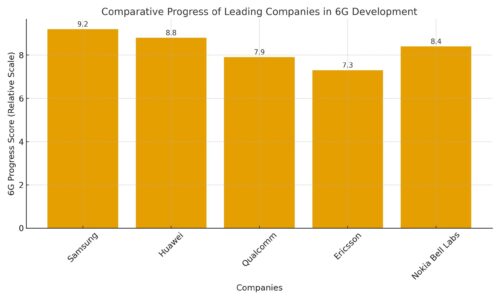
In conclusion, 6G is not simply a faster version of mobile internet — it is a complete technological shift toward AI-native, compute-aware, and fully distributed networks. Future 6G systems will merge ultra-precise sensing, intelligent communications, edge computing, and real time on network processing. Therefore; creating a unified platform for immersive applications, autonomous systems, and hyper-connected devices.
The companies dominating the early 6G patents, publishing influential technical white papers, demonstrating the credible lab prototypes, shaping the chipset roadmaps and securing strong operator partnerships will determine how the global 6G standards evolve.