

Artificial intelligence is changing the way people create video content, and Google Flow AI is emerging as an exciting tool for AI-powered filmmaking. It is designed to help creators turn ideas into cinematic video and combines generative AI with creative controls that can make the video production process faster, more accessible, and more flexible.
If you’ve been searching for a way to turn your creative ideas into cinematic videos without hiring a production crew, Google Flow AI might be the tool you’ve been waiting for. Built on Google’s most advanced generative models, Flow is redefining what’s possible for filmmakers, marketers, and content creators who want professional-quality video without the traditional barriers of cost, equipment, or technical expertise.
What Is Google Flow AI?
Google Flow is an AI-powered creative studio that combines the power of Veo (Google’s state-of-the-art video generation model), Nano Banana (Google’s advanced image engine), and Gemini’s language intelligence into a single, unified workspace. Originally launched as an evolution of Google’s VideoFX experiment, Flow has been grown into a full-scale filmmaking platform where users can generate, edit, and animate video content from simple text prompts or reference images.
Google Flow AI is Google’s AI filmmaking platform, designed to help users create and develop cinematic video content with the help of generative AI. Rather than requiring users to rely entirely on traditional cameras, editing software, and production equipment, Flow aims to put powerful creative tools directly into the hands of creators.
Interestingly, the heart of experience is Google’s generative AI technology, which can help transform text prompts and creative ideas into visual content. This makes it possible to experiment with scenes, characters, camera movements, and visual concepts without building everything from scratch. For creators, the biggest attraction is the potential to move from an idea to a visual concept in a much faster way.
How Does the Google Flow AI Work?
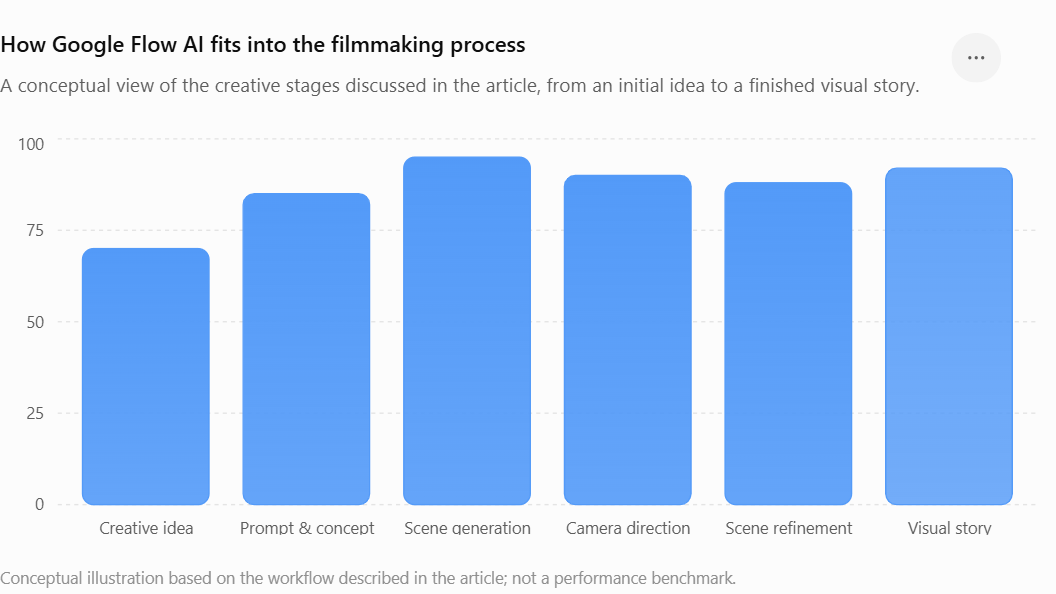
Google Flow is built around an AI-assisted creative workflow. Instead of treating AI as simply a tool that generates a single video clip, Flow is designed to support a broader filmmaking process.
Creators can provide prompts, describing the scene or visual they want to produce. The AI can then generate content based on those instructions. Users can continue refining their ideas, adjusting elements, and developing scenes, as they work toward a finished sequence. This approach is particularly useful for people who want greater creative control than a simple text-to-video generator provides.
For example, a creator could begin with an idea for a science-fiction scene, generate an initial visual, and then develop the concept further by experimenting with different shots, environments, and camera perspectives.
Key Features of Google Flow AI
One of the reasons Google Flow AI has attracted attention is its focus on filmmaking rather than basic video generation.
1. AI Video Generation
Flow uses generative AI to help creators produce video from written instructions and creative concepts. This can dramatically reduce the time required to create early visual concepts. Instead of spending hours in setting up a shot to test an idea, creators can use AI to explore the possibilities quickly.
2. Cinematic Camera Controls
Camera movement is an important part of filmmaking, and AI-generated video becomes more useful when creators can influence how a scene is presented.
Google Flow is designed around cinematic storytelling, giving creators tools for experimenting with perspectives, framing, and camera movement. This can make AI-generated scenes feel more intentional and connected to a larger story.
3. Scene and Story Development
A major advantage of an AI filmmaking workflow is the ability to build on existing ideas.
Rather than generating unrelated clips, creators can work toward developing characters, environments, and sequences that belong to the same creative project. This makes Flow potentially useful for everything from short films and advertisements to storyboards and concept development.
4. Faster Creative Experimentation
Traditional video production can make experimentation expensive. Every new concept may require additional filming, equipment, locations, or editing.
With AI video tools such as Google Flow, creators can test multiple creative directions much more quickly. This can be particularly valuable during the early stages of production, when exploring ideas is more important than producing a final polished video.
Who Can Benefit From Google Flow?
Google Flow AI has potential applications across several industries.
Filmmakers can use AI to explore visual concepts, previsualize scenes, and experiment with the storytelling ideas.
YouTubers and content creators may use AI-generated video to develop original content without requiring a large production team.
Marketers and businesses can explore promotional concepts, advertisements, and visual campaigns more efficiently.
Designers and creative teams can use AI video generation to communicate ideas before investing in full-scale production.
Even beginners can benefit because the technology reduces some of the technical barriers, traditionally associated with filmmaking.
Google Flow AI vs. Traditional Video Production
Traditional filmmaking remains essential for projects requiring real actors, physical locations, specialized cinematography, and precise production control. However, AI tools introduce a different way to approach certain stages of the creative process. The biggest difference is speed.
A traditional production might require a significant investment before a visual idea can be tested. With Google Flow, creators can potentially explore an idea using AI before deciding whether it deserves further investment.
This does not necessarily mean AI will replace traditional filmmaking. Instead, tools such as Flow can complement conventional production by making ideation, experimentation, and the pre-production more efficient.
Why Google Flow AI Matters?
The significance of Google Flow goes beyond to simply generating AI videos. Its broader importance is the way of approaching AI filmmaking as a creative workflow.
Generative AI is moving from producing isolated images and clips toward helping creators to develop the complete visual stories. As these technologies improve, the distinction between writing, directing, cinematography, animation, and editing may become increasingly flexible.
For individuals and small creative teams, this could lower the barriers to producing ambitious visual projects.
The Future of AI Video Creation
Google Flow AI represents part of a much larger shift in how digital content is produced. AI video technology is developing rapidly, and future tools are likely to provide creators with even more control over characters, environments, motion, dialogue, camera work, and editing.
The most successful creators may not necessarily be those who use the most AI. Instead, creative storytelling, strong concepts, and human direction will remain important.
AI can accelerate production, but the quality of the underlying idea still matters.
Final Thoughts
Google Flow AI offers an intriguing glimpse into the future of filmmaking. By combining generative AI with the tools designed around cinematic storytelling, it gives creators new ways to transform ideas into visual experiences.
For filmmakers, marketers, content creators, and creative professionals, the technology provides an opportunity to experiment faster and explore concepts that might previously have been difficult or expensive to produce.
As AI video generation continues to evolve, Google Flow could become an important part of the modern creative toolkit—helping people spend less time in overcoming technical barriers and more time in developing compelling stories.