

Probably not as full 6G phones. A phone needs compatible radio hardware, antennas, and software to connect using a network’s 6G technology. Today’s 5G phones are built for 5G, so a software update alone is unlikely to make them support 6G.
However, that does not mean your 5G phone will suddenly stop working when 6G arrives. If your carrier continues operating 4G and 5G networks, your phone should keep using the networks it already supports.
The key distinction is simple: a 5G phone may continue working after 6G launches, but that does not make it a 6G phone.
Why can’t a 5G phone just get a 6G update?
A smartphone connects to cellular networks using a modem, radio-frequency components, antennas, and software designed to work together. A manufacturer can sometimes add or improve features through software, but software cannot replace radio hardware that a phone does not have.
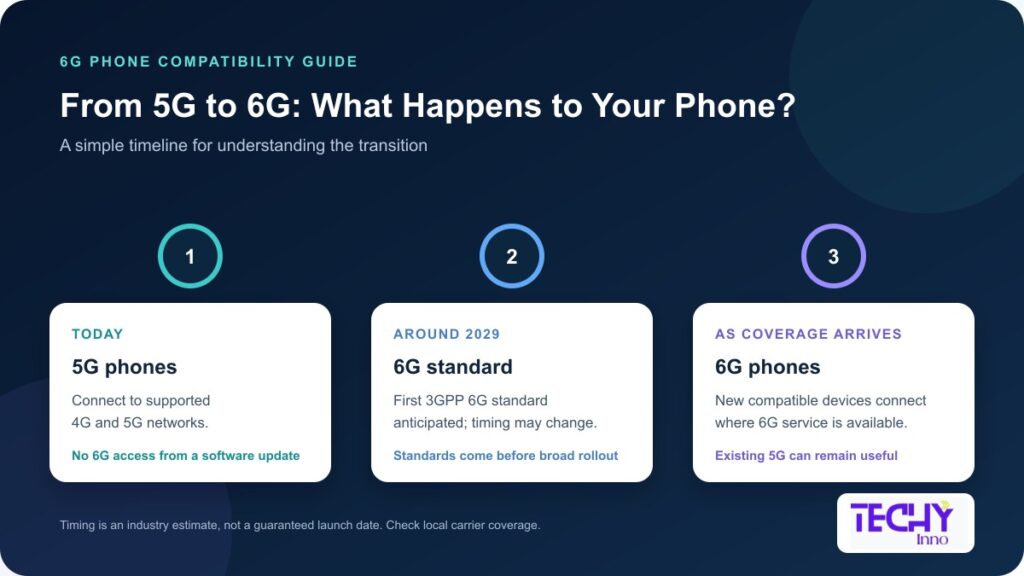
The final 6G specifications are still being developed. The International Telecommunication Union (ITU) calls the next generation as IMT-2030 and is working through requirements and evaluation for candidate technologies. 3GPP’s Release 21 is expected to define the first 6G specifications with completion anticipated around 2029.
As a result, phone makers cannot yet sell a normal consumer smartphone with confirmed support for a finalized, widely deployed 6G standard. A device described as “6G-ready” today may be referring to research, a prototype, or a company’s future plans—not a guarantee that the phone can connect to commercial 6G networks.
Will 5G phones still work when 6G launches?
In many cases, yes—where compatible 4G or 5G service remains available. Network generations can overlap. Carriers do not usually switch off every older network worldwide on the day a newer one launches. Instead, they introduce new service gradually, and the timing varies by country and operator.
Therefore, your current phone should continue to connect to the network types it supports, subject to your carrier’s coverage, service plans, and network shutdown schedule. A 5G phone would not automatically gain access to 6G. To use 6G radio service, you will likely need a phone specifically designed and certified for the relevant 6G standards and frequency bands.
| Phone type | Expected connection |
|---|---|
| Current 5G phone | 4G and 5G networks it supports |
| Future 6G phone | 6G, and potentially 5G or 4G where supported |
| “6G-ready” phone without confirmed specifications | Check the manufacturer’s exact claim; the label alone proves little |
Can a future 6G phone will support 5G?
It is plausible that future 6G phones will support older networks (including 5G) to help users stay connected, where 6G coverage is not available. But the precise requirements will depend on the standards, device design, and carrier certifications adopted for commercial networks. Until those details are finalized, claims about exactly which phones will support both generations should be treated as predictions.
Qualcomm describes 5G Advanced as a bridge toward 6G, and explains that some 6G enhancements may also improve existing 5G deployments. That points to an evolving transition, rather than an overnight change in which every network and phone is replaced at once.
When will 6G phones be available?
There is no confirmed release date for a mainstream 6G smartphone. Qualcomm says the first 3GPP 6G standard is anticipated in 2029, while the commercial 6G service is expected only after standardization and network development. The company and other industry leaders have also described a path toward initial commercial systems starting from 2029 onward—but that is an industry outlook, not a promise that 6G will be available everywhere then.
In practice, the first 6G launches may be limited to selected markets. Wider coverage, more compatible devices, and affordable 6G phones would take additional time. So if you are asking, “Should I wait for a 6G phone?” the practical answer is: don’t postpone a needed phone purchase based only on a 6G promise. However, consider upgrading when 6G phones and service are actually available in your area.
How to spot misleading 6G phone claims?
Before trusting a headline or product listing, check whether it names a specific phone model, cites an official manufacturer announcement, and explains the network standard the device supports. The phrase “6G-ready” should be taken into account very carefully. It can sound like a buying guarantee, but without published specifications and certification details, it may only mean that a company expects its future products to support 6G. Additionally, 6 GHz is not the same thing as 6G. A reference to the 6 GHz frequency band doesn’t itself mean a smartphone supports 6G cellular service.
The takeaway: 5G phones won’t become 6G phones—but they can remain useful
Today’s 5G phones are not expected to turn into 6G devices through a simple update. They may remain usable on 4G and 5G networks for years, depending on carrier support and coverage. When commercial 6G service arrives, a compatible 6G phone will likely be needed to access its new radio technology.
For now, the best way to prepare is to follow official device announcements and your carrier’s roll-out plans—not rumors. 6G is on the road map, but for most smartphone buyers, a reliable 5G phone remains the practical choice until 6G networks and certified phones are available locally.